
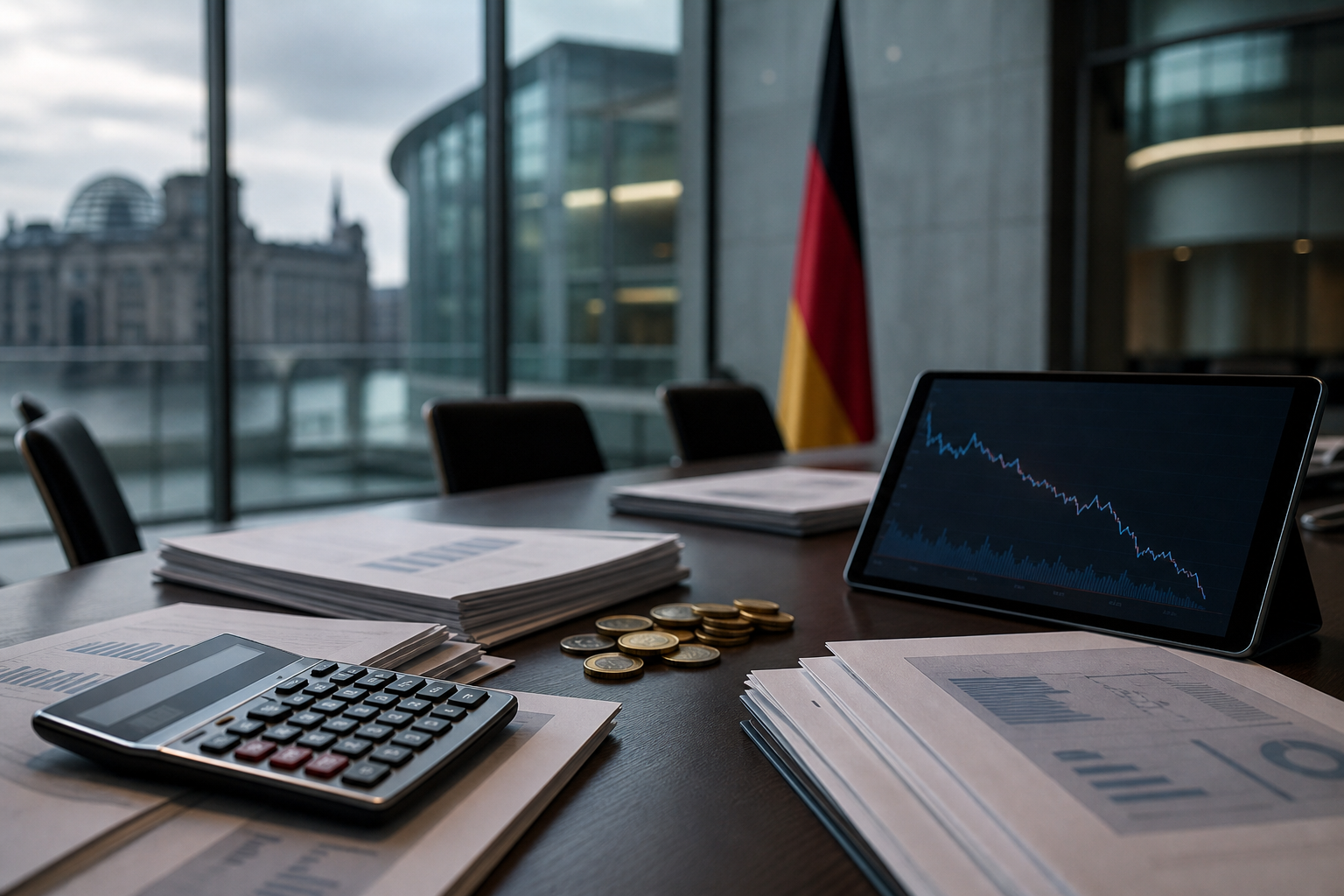
Tax debate meets weaker economy
Kretschmer open to higher taxes for the rich – DIHK significantly lowers growth forecast
Saxony's Minister President Michael Kretschmer (CDU) links the debate about working hours and willingness to perform with a sensitive financing question: He calls for more full-time work – and at the same time shows himself open to higher levies on large fortunes and inheritances, if relief for lower incomes cannot be achieved otherwise. At the same time, the German Chamber of Industry and Commerce (DIHK) is noticeably dampening the economic outlook and warning of additional burdens for companies.
Kretschmer links labor debate and distribution issue
Kretschmer told the "Neue Osnabrücker Zeitung" that in the end, solutions must be found that benefit everyone. He named, among other things, job security and reliable tax revenues as goals. His call for more full-time work thus places the issue in a broader context: It is not just about individual working time models, but about the question of how the state can finance relief and at the same time keep revenues stable.
The second part of his initiative is more politically sensitive. Kretschmer showed himself open to higher taxes on large fortunes and inheritances – but expressly as the last element of a reform package intended to relieve lower incomes. This is not an immediate legislative announcement nor a fully formulated tax concept. It is initially a positioning in a classic distribution debate: Who should bear additional burdens if relief for lower and middle incomes is promised at the same time?
For classification, it is crucial what does not yet follow from this: Neither is a concrete decision known nor a package of measures that maps the sequence "relief first, tax increase last" in figures and timelines. However, it is clear that Kretschmer is bringing together two lines of conflict that are often negotiated separately in politics – the expectation of more gainful employment and the question of a stronger participation of very large fortunes in financing state tasks.
DIHK forecast: less growth, more pressure on location policy
While Kretschmer talks about possible levers on the revenue side, the economy is giving a much more pessimistic outlook. DIHK Chief Executive Helena Melnikov told "Welt am Sonntag" that the chamber now expects only a 0.3 percent increase for the current year. At the beginning of the year, they had expected 1.0 percent.
Melnikov justified the deterioration mainly with the Iran war. As a result, energy and raw material prices have risen sharply; for many companies, this is an additional burden. The forecast is thus not just a business cycle figure, but a political message: When cost and uncertainty factors intensify, the scope for additional requirements shrinks from the companies' point of view – and the call for relief, faster procedures, and reliable framework conditions becomes louder.
It is striking that: At the beginning of 2026, the DIHK had mentioned growth of 1.0 percent in its economic communication. The fact that now 0.3 percent is being mentioned in an interview shows at least how quickly expectations can shift – and how strongly economic policy debates are driven by current crises, energy prices, and foreign policy risks.
News of the day: tightened procedures, diplomatic expectations, dispute over crisis management
Tightened Green Card procedures in the USA
According to the immigration authority, the US government is tightening the hurdles for obtaining the so-called Green Card, which allows foreigners permanent residence in the USA. According to a directive, the consular procedure in the home country should generally be used for this purpose. Until now, tourists, students, or other visitors could also apply directly for a Green Card in the USA under certain conditions. The core of the change is thus less a general "if" than a more strictly defined "how": Access remains possible, but the process to get there is becoming more restrictive procedurally.
Diplomatic expectations for the NATO summit
In foreign policy, Federal Foreign Minister Johann Wadephul (CDU) expressed confidence regarding NATO. At a meeting with colleagues in Helsingborg, Sweden, he said US Secretary of State Marco Rubio had emphasized the alliance's unity. Rubio had agreed that the NATO summit in Ankara in six weeks should send a signal of unity. At the same time, the context remains that US President Donald Trump has repeatedly sharply criticized European NATO partners. Wadephul's statements thus primarily mark a diplomatic expectation – not an already secured result regarding the future course.
Dispute over rescue operation for stranded humpback whale
In Mecklenburg-Western Pomerania, Environment Minister Till Backhaus (SPD) defended his approach to the rescue attempt of a humpback whale stranded in the Baltic Sea against criticism. He told "Stern" that he had acted responsibly; he did not accept that the marine mammal had suffered longer due to the rescue operation by a private initiative. Backhaus also said that it made him sad that the whale was dead. The humpback whale had stranded several times in the Baltic Sea since March. The case is politically relevant mainly because it touches on the question of how state action is evaluated and controlled in emotionally charged individual cases – and which standards should apply when weighing animal welfare, risk, and responsibilities.
Frequently Asked Questions
Sources
- https://www.mdr.de/nachrichten/nachrichten100.html, 23.05.262026
- https://www.dihk.de/de/newsroom/konjunktur-jahresbeginn-2026-167022, 17.02.2026
- https://www.auswaertiges-amt.de/en/aussenpolitik/sicherheitspolitik/wadephul-nato-helsingborg-globsec-forum-prague-2772690, 21.05.2026
- https://www.regierung-mv.de/Aktuell/?id=219759&processor=processor.sa.pressemitteilung, 02.05.2026