Local Scene Events & Influencer Meetups in Munich
Local Scene Events & Influencer Meetups in Munich (from now and for the coming months)
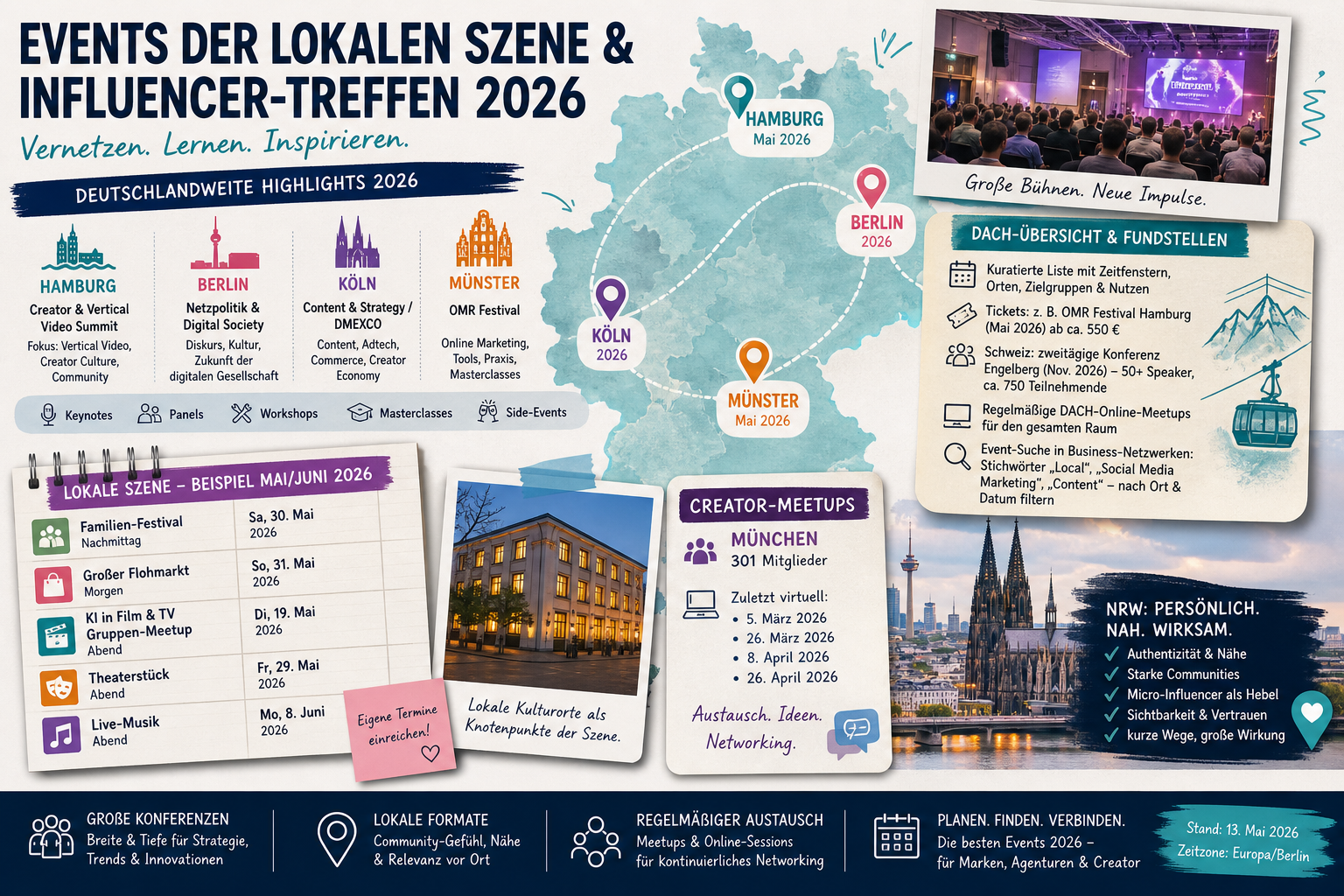
If you want to become more visible as a creator, social media manager, or entrepreneur in Munich, one thing often gets you ahead faster than yet another online course: meeting the right people in real life. The local scene offers formats that are deliberately small, approachable, and recurring – making them ideal for building long-term collaborations, content ideas, and trust.
Important: This guide does not list individual dates that may already have passed, but instead explains how you can reliably find future events, meetups, and conferences and use them strategically for your goals.
Munich as a Scene Hub: typical hotspots & formats
In Munich, influencer and creator contacts rarely arise only through “influencer events” in the narrow sense. More often, they are places and programs where culture, creative industries, tech, and communications intersect. For your search for future dates, these formats are especially relevant:
1) Open Community Meetups
Low-threshold evenings with a short introduction round, relaxed conversations, and thematic impulses (e.g., “Reels workflow”, “Creator rates & packages”, “AI tools in content production”). Ideal if you want to make new contacts without pitch pressure.
2) Workshops & Skill Sessions
Practical formats on production, storytelling, editing, lighting/sound, social SEO, brand building, or community management. They are especially valuable if you want to go home not just with “networking” but with concrete results.
3) Cultural & Neighborhood Formats with Content Potential
Local festivals, readings, exhibitions, markets, or panel evenings are often perfect “content anchors”: you meet people with local stories and find motifs that don’t look like interchangeable stock content. The key is to discover planned dates early – and to clarify accreditation or filming permits in time, if necessary.
4) Industry Meetings (Marketing, Startups, Media, Tech)
These events are often the best bridge to companies, agencies, and tools – that is, to potential clients. For creators, a clear positioning is worthwhile here (“What do you offer, for whom, with what result?”), so that conversations don’t fizzle out in small talk.
Influencer Meetups & Creator Groups: how they work
Regular creator groups are a stable engine of the scene in many cities. In Munich, you typically find such formats as in-person meetings, online meetups, or hybrid evenings. A proven process often looks like this:
- Short introduction round (niche, platforms, current goal).
- Focus topic (e.g., “negotiating collaborations”, “planning content series”, “community guidelines”).
- Peer feedback (e.g., profile review, hook check, thumbnails, sponsorship pitches).
- Networking with clear “next steps” (e.g., follow-up list, collab ideas, appointments).
What makes such meetings particularly effective is the combination of commitment and a safe space: you can ask questions that you rarely address openly in a large conference situation (e.g., pricing models, workload, stress, boundaries in collaborations). For this to work, pay attention to groups that have clear rules for respectful interaction and transparency.
DACH Agenda & Global Trends: how to plan your year
A realistic annual plan is the difference between “constantly busy” and “strategically visible”. Here’s how you can structure your creator or marketing year from today:
- Monthly: 1 local meetup or workshop (consistency beats intensity).
- Quarterly: 1 thematic special format (e.g., paid social, analytics, creator economy, law/taxes).
- 1–2× per year: a larger conference in the DACH region, if it fits your focus (e.g., content, social ads, platform trends, creator partnerships).
- Ongoing: short online sessions/webinars if you want to solve a specific problem (e.g., new ad formats, reporting, workflow).
Global developments you can consider when choosing events:
- More focus on short video & series content (hooks, retention, recognizability).
- Professionalization of brand safety & transparency (ad labeling, clear briefings, documented approvals).
- Creators as entrepreneurs (productization of services, recurring formats, clean processes).
How to find suitable events in Munich (step-by-step)
So you don’t get lost in the calendar jungle, use a repeatable search routine focused on future dates:
-
Define your focus in one sentence.
Example: “I create food content in Munich and am looking for collaborations with local businesses” or “I work as a social media manager and want to build creator partnerships.”
-
Search in 3 channels in parallel.
- Event platforms (filter: Munich, date from today, topics: social media, marketing, creator, video).
- Business networks with event search (e.g., industry groups, local chapters, thematic communities).
- Local culture & neighborhood calendars (for authentic settings and story opportunities).
-
Evaluate each event with 5 questions.
- Does it fit my goal (learning, networking, leads, inspiration)?
- Is the target group compatible (creators, brands, agencies, media, local scene)?
- How high is the practical share (workshop, feedback, open slots)?
- How easy is it to start a conversation (small/structured vs. very large)?
- What is the price-performance ratio (time, travel, ticket, output)?
-
Build yourself an “event shortlist” for 8–12 weeks.
Only enter dates you can actually attend. Also plan for buffer: a good meetup only has an effect if you have time for follow-ups.
Checklist: Preparation, Networking, Follow-up
Before the event (30–60 minutes is often enough)
- Profile check: bio, contact option, current highlight/pin, clear topic assignment.
- Mini-pitch: 1–2 sentences about what you do and who you’re looking for (collab, mentor, client, sparring).
- Examples: 2–3 concrete pieces of content or cases you can show (saved on your phone or linked).
- Boundaries: What you reject (e.g., unpaid use, exclusive rights without compensation, “only for product”).
During the event
- Quality over quantity: 3 good conversations are worth more than 20 business cards.
- Questions that work: “What are you working on right now?”, “Which collaborations are worthwhile for you?”, “What are you looking for in Munich?”
- Take notes: name, topic, next step (e.g., “intro to X”, “call next week”).
After the event (within 48 hours)
- Follow-up with a concrete reference (“You mentioned XYZ…”).
- A next appointment (coffee chat, short call, joint shoot).
- Mini-CRM (Notion/sheet): contacts, status, next action.
Law, Transparency & Safety in Collaborations
Events are for networking – but also a place where collaborations are initiated. For trust (and long-term cooperation), these points are central:
- Ad labeling & transparency: If content is promotional, it must be clearly recognizable as advertising. Follow the rules applicable in Germany and the requirements of the respective platform.
- Written agreements: briefing, deliverables, usage rights, exclusivity, approval processes, payment terms – the clearer, the fewer conflicts.
- Data protection & image rights: Clarify at event recordings whether and where you are allowed to film/photograph. Respect no-film zones and consents.
- Safety & boundaries: Prefer to meet for follow-ups in public settings. If an offer puts you under pressure (“agree immediately”), caution is advised.
Note: This article is not legal advice. For legally binding assessments, contact a qualified legal advisor or use reliable guides from consumer and media institutions.