
Franz von Stuck
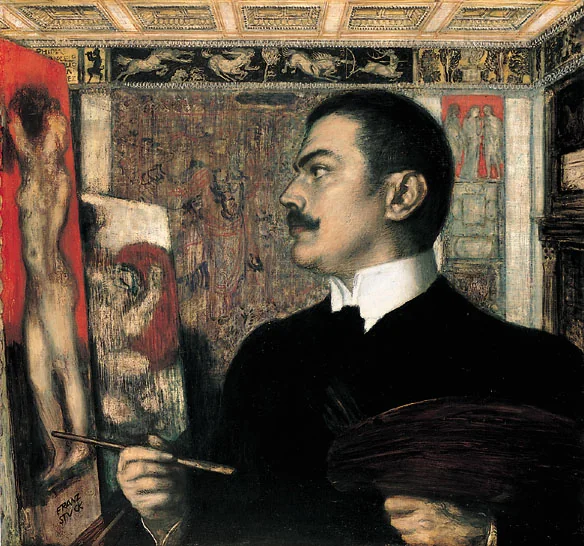
Image from Wikipedia
Image from Wikipedia
Franz von Stuck – Symbolist, Jugendstil Pioneer and Creator of an Artistic Cosmos
A Master of the Grand Gesture Between Myth, Modernity, and Munich's Global Standing
Franz von Stuck is one of the most influential German artists of the late 19th and early 20th centuries. Born in 1863 in Tettenweis and died in Munich in 1928, he evolved from a talented draftsman into a celebrated painter, sculptor, and designer of a stylistically defining Gesamtkunstwerk. His career intertwines academic training, symbolic imagery, Jugendstil staging, and social ascent in a manner that continues to fascinate to this day. ([de.wikipedia.org](https://de.wikipedia.org/wiki/Franz_von_Stuck))
Biography: From a Lower Bavarian Talent to the Prince of Painters in Munich
Franz Stuck demonstrated artistic talent early on, encouraged by his mother. After attending the local vocational school in Passau, he studied at the Munich School of Applied Arts starting in 1878 and transferred to the Academy of Fine Arts in Munich in 1881. Even during his training, he earned a living through applied arts projects, honing his keen eye for form, ornament, and graphic effect. ([bavarikon.de](https://www.bavarikon.de/object/bav%3AHKO-NDB-00000000SFZ31093))
His breakthrough did not begin with a single image but with an impressive series of drawings, portfolios, and humorous contributions. Works like "Allegories and Emblems" as well as "Cards & Vignettes" established his reputation as a draughtsman; further adding to this were works for the "Fliegenden Blätter," which showcased his precise line and satirical instinct. In 1889, he achieved his artistic breakthrough at the exhibition in the Munich Glass Palace, where "The Guardian of Paradise" was awarded. ([bavarikon.de](https://www.bavarikon.de/object/bav%3AHKO-NDB-00000000SFZ31093))
The Rise in Munich's Art Scene
With the Munich Secession, Stuck became a central figure in the modern art movement in Bavaria. He was among the founding members of the exhibition community and designed attention-grabbing posters for them multiple times. At the same time, his participation in the state acquisition commission allowed him to influence Munich's art policy, securing a permanent position at the center of the institutions. ([bavarikon.de](https://www.bavarikon.de/object/bav%3AHKO-NDB-00000000SFZ31093))
In 1895, he became a professor at the Academy of Fine Arts in Munich and shaped an entire generation. His students included prominent figures such as Wassily Kandinsky and Paul Klee, whose later developments would be inconceivable without the academic discipline and imaginative perspective instilled by Stuck. That a symbolist with a flair for the theatrical taught at an academy lent additional weight to his name. ([de.wikipedia.org](https://de.wikipedia.org/wiki/Franz_von_Stuck))
Breakthrough, Fame, and Social Ascendancy
The artist's reputation grew not only through exhibitions but also through prestigious commissions. In 1895, he received the commission to decorate the Reichstag building in Berlin, and in 1897 he began constructing his villa on the Isar, which he envisioned as a Gesamtkunstwerk and later expanded with an atelier building. The house not only demonstrated his social ascent but also his ambition to unify art, architecture, furniture, and sculpture within a single artistic language. ([bavarikon.de](https://www.bavarikon.de/object/bav%3AHKO-NDB-00000000SFZ31093))
In 1905, Prince Regent Luitpold awarded him the Knight's Cross of the Order of Merit of the Bavarian Crown; in 1906 he could call himself "Ritter von Stuck" after his entry into the nobility. Further honors followed, including the Commander's Cross in 1912 and, shortly before his death, an honorary doctorate from the Technical University of Munich. These accolades document how profoundly Stuck rose from being an artistic outsider to an institutionally recognized authority. ([de.wikipedia.org](https://de.wikipedia.org/wiki/Franz_von_Stuck))
Work and Expression: Symbolism, Jugendstil, and the Power of the Image
Stuck's imagery draws from mythology, allegory, and antiquity. Inspired by Arnold Böcklin, he developed ethereal, surreal compositions in which mythical creatures like fauns, Pan, centaurs, and sphinxes become main characters. His art combined neoclassicism, Jugendstil, and symbolic density into an unmistakable language that transformed contemporary themes into a timeless visual stage. ([de.wikipedia.org](https://de.wikipedia.org/wiki/Franz_von_Stuck))
His most famous works include "Sin" from 1893 and "War" from 1894. Both paintings exemplify the typical tension in his art: an elegant, decorative surface paired with an uneasy, at times lascivious atmosphere that challenged bourgeois moral standards. This very blend of beauty, threat, and symbolic elevation made Stuck one of the most distinctive image artists of his era. ([de.wikipedia.org](https://de.wikipedia.org/wiki/Franz_von_Stuck))
sculpture, Space Art, and the Principle of the Gesamtkunstwerk
Stuck did not think in isolated works, but in orchestrations. His villa in Munich exemplifies this program: self-created furniture, sculptures, and a carefully composed sequence of spaces made the house a stage for his aesthetic world. The villa, which has later become a museum, is still regarded today as a key work of Munich Jugendstil and as a manifesto of symbolist spatial art. ([de.wikipedia.org](https://de.wikipedia.org/wiki/Franz_von_Stuck))
In his paintings, he also placed great emphasis on framing and presentation. According to the Web Gallery of Art, he often designed the frames himself, ensuring that gold, relief, inscriptions, and panel structure appeared as integral parts of the work. This attitude underscores his aim to merge image and object, content and form, composition and staging inseparably. ([wga.hu](https://www.wga.hu/bio_m/s/stuck/biograph.html))
Reception: Fame, Critique, and Later Reassessment
During his lifetime, Stuck achieved international success, with presentations in cities such as St. Petersburg, Moscow, and Venice. Simultaneously, from 1904 onward, criticism intensified, as some observers found his art decorative and backward-looking. This very dichotomy makes his career historically interesting: Stuck was both a celebrated representative artist and a projection surface for the conflict between symbolism, modernity, and academic tradition. ([bavarikon.de](https://www.bavarikon.de/object/bav%3AHKO-NDB-00000000SFZ31093))
Later scholarship has identified him more clearly as a key figure of German symbolism. The Munich Villa Stuck has been interpreted not only as a Jugendstil museum but also as a dense mental space of an artist who connected biographical, esoteric, and ancient elements. This reassessment shifted the focus from mere decorativeness to a complex, rich artistic output. ([de.wikipedia.org](https://de.wikipedia.org/wiki/Franz_von_Stuck))
Franz von Stuck and the Art History of the 20th Century
Stuck's influence extends far beyond his own works. As a teacher, he impacted later pioneers of modernity, including Kandinsky and Klee, and as a networker, he shaped Munich's artist associations and the official art policy of his time. His career exemplifies how tightly intertwined style development, institutions, commissions, and public impact were in German art around 1900. ([de.wikipedia.org](https://de.wikipedia.org/wiki/Franz_von_Stuck))
He also holds a secure place in the history of European symbolism. In addition to his role as a painter, he acted as a draughtsman, designer, and sculptor, creating a visual language characterized by eroticism, myth, and drama. He thus became a figure who not only accompanied but also actively shaped the transition from the 19th century to aesthetic modernity. ([de.wikipedia.org](https://de.wikipedia.org/wiki/Franz_von_Stuck))
Discography, Hits, and Current Projects: An Artistic Overview Instead of Music Releases
There is no classical discography for Franz von Stuck, as he was not a musician but a draughtsman, painter, and sculptor. His "hits" in an art historical sense are rather the canonical works that continue to define his profile today: "Sin," "War," "The Struggle for Woman," and the Villa Stuck as a Gesamtkunstwerk. These works form the core of his reception and represent that mixture of symbolism, Jugendstil, and psychological incisiveness that makes his style so memorable. ([de.wikipedia.org](https://de.wikipedia.org/wiki/Franz_von_Stuck))
There are no current projects in terms of new releases, as Stuck passed away in 1928. Contemporary engagement with his work mainly takes place today through exhibitions, museum presentations, catalogs, and art historical reassessments. Modern relevance thus arises not from new works but from the ongoing visibility of his oeuvre in research and museum culture. ([de.wikipedia.org](https://de.wikipedia.org/wiki/Franz_von_Stuck))
Voices of the Fans
No official profile found.
Conclusion: Why Franz von Stuck Continues to Electrify Today
Franz von Stuck remains intriguing because his art is far more than just beautiful Jugendstil or a symbolic pose. He combined technical precision, iconic visual motifs, social ascendance, and an uncompromising sense of staging into an unmistakable artistic identity. Those who examine his works and the Villa Stuck encounter an artist who co-shaped the stage of modernity and masterfully navigated its tension between seduction and abyss. ([de.wikipedia.org](https://de.wikipedia.org/wiki/Franz_von_Stuck))
For this reason, encountering Franz von Stuck in the museum and through art historical reading continually proves worthwhile. His visual world remains intense, theatrical, and highly dense, showcasing how powerful symbolism and Jugendstil can function as expressions of an entire era. Those who wish to experience the visual impact, intellectual depth, and cultural influence of this artist should study his works in their original form. ([de.wikipedia.org](https://de.wikipedia.org/wiki/Franz_von_Stuck))
Official Channels of Franz von Stuck:
- Instagram: no official profile found
- Facebook: no official profile found
- YouTube: no official profile found
- Spotify: no official profile found
- TikTok: no official profile found