
Viviane Hagner
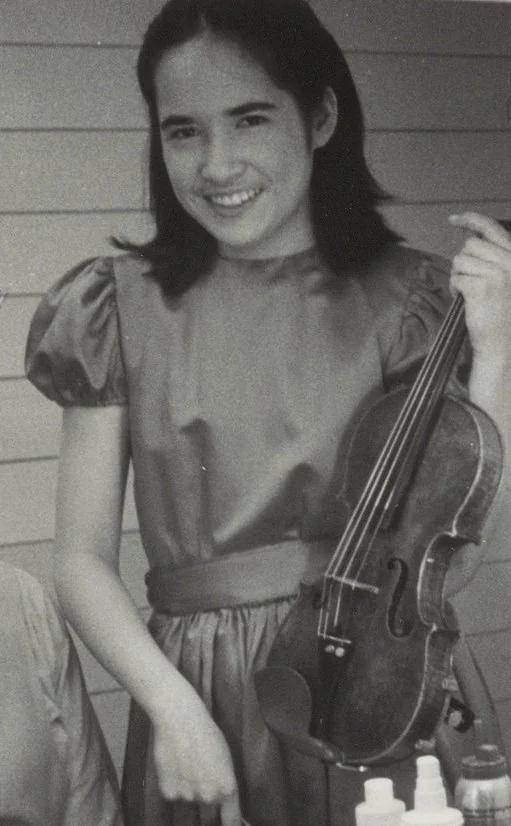
Image from Wikipedia
Image from Wikipedia
Viviane Hagner – The German Violinist Between Virtuosity, Chamber Music, and Artistic Attitude
An Exceptional Artist with an International Profile
Viviane Hagner is one of the most prominent German violinists of her generation. Born in 1976 in Munich and raised with German-Korean roots, she developed an early music career based not only on technical brilliance but also on artistic attitude, depth of repertoire, and curiosity about the unknown. She made her international debut at the age of twelve; shortly thereafter, she performed in Tel Aviv with the Israel Philharmonic Orchestra and the Berlin Philharmonic under Zubin Mehta, a moment that profoundly shaped her career. ([en.wikipedia.org](https://en.wikipedia.org/wiki/Viviane_Hagner?utm_source=openai))
Early Influence and the Path to the Violin
Initially, Hagner began as a pianist before making an early switch to the violin, a transition that continues to influence her musical language today. The combination of clear awareness of form, chamber music thinking, and solo presence points to an education that aims not at mere showmanship but at substance. As a teenager, she moved in an environment that familiarized her with great orchestras, renowned conductors, and demanding concert programs. ([en.wikipedia.org](https://en.wikipedia.org/wiki/Viviane_Hagner?utm_source=openai))
The International Breakthrough: Tel Aviv as a Key Moment
The early breakthrough in Tel Aviv marked not just the start of her career but entry into the top tier of the international concert scene. That she performed at such a prominent venue at the age of 13 illustrates the remarkable maturity of her playing and the trust placed in her at a young age. Critics later repeatedly emphasized her intelligence, musicianship, and classical nobility; the Los Angeles Times described her as an artist with a significant foundation of achievements and comparisons to the great names in conducting. ([latimes.com](https://www.latimes.com/archives/la-xpm-2003-may-07-et-ginell7-story.html?utm_source=openai))
Study Years, Mentors, and American Influence
During her studies in the USA, Hagner participated in the Marlboro Music Festival, a prestigious institution of chamber music known for intensive rehearsal work, collegial playing, and artistic exchange. Her encounter with Pinchas Zukerman, facilitated by Daniel Barenboim, is also a formative stage in her development; she subsequently studied at the Manhattan School of Music. These influences explain why her playing today feels not only soloistic but always dialogical and ensemble-oriented. ([en.wikipedia.org](https://en.wikipedia.org/wiki/Viviane_Hagner?utm_source=openai))
A Repertoire Between Classical, Modern, and World Premiere
Hagner represents a repertoire that connects classical violin literature with contemporary music. She has worked with conductors such as Daniel Barenboim, Claudio Abbado, Zubin Mehta, Vladimir Ashkenazy, Pinchas Zukerman, and Marek Janowski, thus collaborating with personalities who embody different ideals of interpretation. At the same time, she has established herself as an advocate for new works: in 2002, she performed the world premiere of Unsuk Chin's Violin Concerto with the Deutsches Symphonie-Orchester Berlin under Kent Nagano, followed by the premiere of Simon Holt's Violin Concerto with the BBC Symphony Orchestra under Jonathan Nott in 2006. ([en.wikipedia.org](https://en.wikipedia.org/wiki/Viviane_Hagner?utm_source=openai))
Sound Ideal, Instrument, and Technical Sovereignty
Until September 2012, Hagner played the Stradivari "Sasserno" from 1717, which was provided to her by the Nippon Music Foundation. This instrument underscores the high caliber of her music career and points to a sound ideal that emphasizes nobility, resonance, and color differentiation. Descriptions of her work frequently include terms like “intelligent,” “musical,” and “understanding” – indications that her interpretations are based more on inner logic and stylistic control than on external brilliance. ([en.wikipedia.org](https://en.wikipedia.org/wiki/Viviane_Hagner?utm_source=openai))
Chamber Music as the Artistic Center
A significant part of Hagner's profile lies in chamber music. She regularly performs with her sister Nicole Hagner, a pianist, with whom she forms a well-rehearsed duo. This constellation represents a particularly close musical communication, where phrased breathing, balance, and dynamic fine-tuning play a central role. She is also firmly established in the international festival scene, including at the Marlboro Music Festival, which has provided her with important impulses for her chamber music work over the years. ([en.wikipedia.org](https://en.wikipedia.org/wiki/Viviane_Hagner?utm_source=openai))
Discography: From Beethoven to Unsuk Chin
Hagner's discography reflects her stylistic range. Early recordings include chamber works by Beethoven, Schubert, and Saint-Saëns on EMI Classics, along with repertoire featuring Tchaikovsky and Mendelssohn concertos. In 2006, she released "Ciaconna," an album bringing together Bach, Bartók, and Hartmann, showcasing her preference for structurally dense, expressively charged literature. Later, she released the Vieuxtemps recordings with Hyperion, the recording of Unsuk Chin's first Violin Concerto, as well as Christian Jost's concerto "TiefenRausche," which received critical acclaim. ([en.wikipedia.org](https://en.wikipedia.org/wiki/Viviane_Hagner?utm_source=openai))
Recent Releases and Current Artistic Work
In recent years, Hagner has remained active. Sources mention a release of "Tansman & Bruch: Works for Violin & Orchestra," which is set to be released in March 2026 by Accentus Music, as well as her participation in the "Mendelssohn Project" with the Dogma Chamber Orchestra. Concurrently, she maintains visibility as a festival and chamber music personality, for instance at the Gezeitenkonzerten 2024 in Wittmund, where she performed with musicians from her network. Her current work thus combines concert activities, recording projects, and curatorial responsibilities. ([qobuz.com](https://www.qobuz.com/us-en/interpreter/viviane-hagner/41739))
Teaching, Promoting Young Talent, and Academic Authority
From 2009 to 2013, Hagner served as a junior professor at the University of the Arts Berlin; since 2013, she has been teaching at the State University of Music and Performing Arts Mannheim. This academic positioning strengthens her authority well beyond the stage, as she conveys not only technical skill but also a musical way of thinking. Additionally, she engages in masterclasses and projects aimed at expanding access to classical music and supporting young musicians. ([de.wikipedia.org](https://de.wikipedia.org/wiki/Viviane_Hagner?utm_source=openai))
Krzyżowa-Music: Cultural Exchange as a Mission
In 2013, Hagner co-founded the Krzyżowa-Music Festival with Matthias von Hülsen, where she serves as artistic director. The project focuses on collaboration between experienced and young musicians and aims to promote understanding through music – a culturally political approach that adds special depth to her biography. Hagner's receipt of the Order of Merit of the Federal Republic of Germany for her work in this German-Polish exchange emphasizes the societal relevance of her commitment. ([jamesbrownmanagement.com](https://www.jamesbrownmanagement.com/wp-content/uploads/2013/01/Viviane-Hagner-Biography-2024-25.pdf))
Style, Impact, and Cultural Influence
Viviane Hagner embodies a form of artistic excellence grounded in discipline, curiosity, and repertoire responsibility. She is not a violinist who reduces herself to mere virtuosity; rather, she combines technical sovereignty with interpretive insight and a noticeable preference for demanding, often rarely played music. It is precisely this blend of tradition and modernity, of solo culture and chamber music, that makes her cultural influence in the European classical scene so lasting. ([en.wikipedia.org](https://en.wikipedia.org/wiki/Viviane_Hagner?utm_source=openai))
Conclusion: A Violinist with Attitude and Charisma
Viviane Hagner captivates because she understands the violin as an instrument of dialogue, precision, and intellectual tension. Her career uniquely combines early mastery, international presence, pedagogical responsibility, and cultural engagement. Those who experience her live encounter an artist who not only plays but opens musical spaces – intensely, clearly, and with a distinctive personality. ([jamesbrownmanagement.com](https://www.jamesbrownmanagement.com/wp-content/uploads/2013/01/Viviane-Hagner-Biography-2024-25.pdf))
Official Channels of Viviane Hagner:
- Instagram: No official profile found
- Facebook: No official profile found
- YouTube: No official profile found
- Spotify: No official profile found
- TikTok: No official profile found
Sources:
- Wikipedia – Viviane Hagner
- James Brown Management – Viviane Hagner Biography 2024-25
- Krzyżowa-Music – About us
- Krzyżowa-Music – Press & Media
- Utah Symphony – Passion Project: Viviane Hagner
- Qobuz – Viviane Hagner Discography
- Deutsche Radio Philharmonie – Program booklet 2025
- Ostfriesische Landschaft – Press release Gezeitenkonzert 2024
- Wikipedia: Image and text source